Journeys
IFS Cloud BAU and Evergreen updates as managed cycles
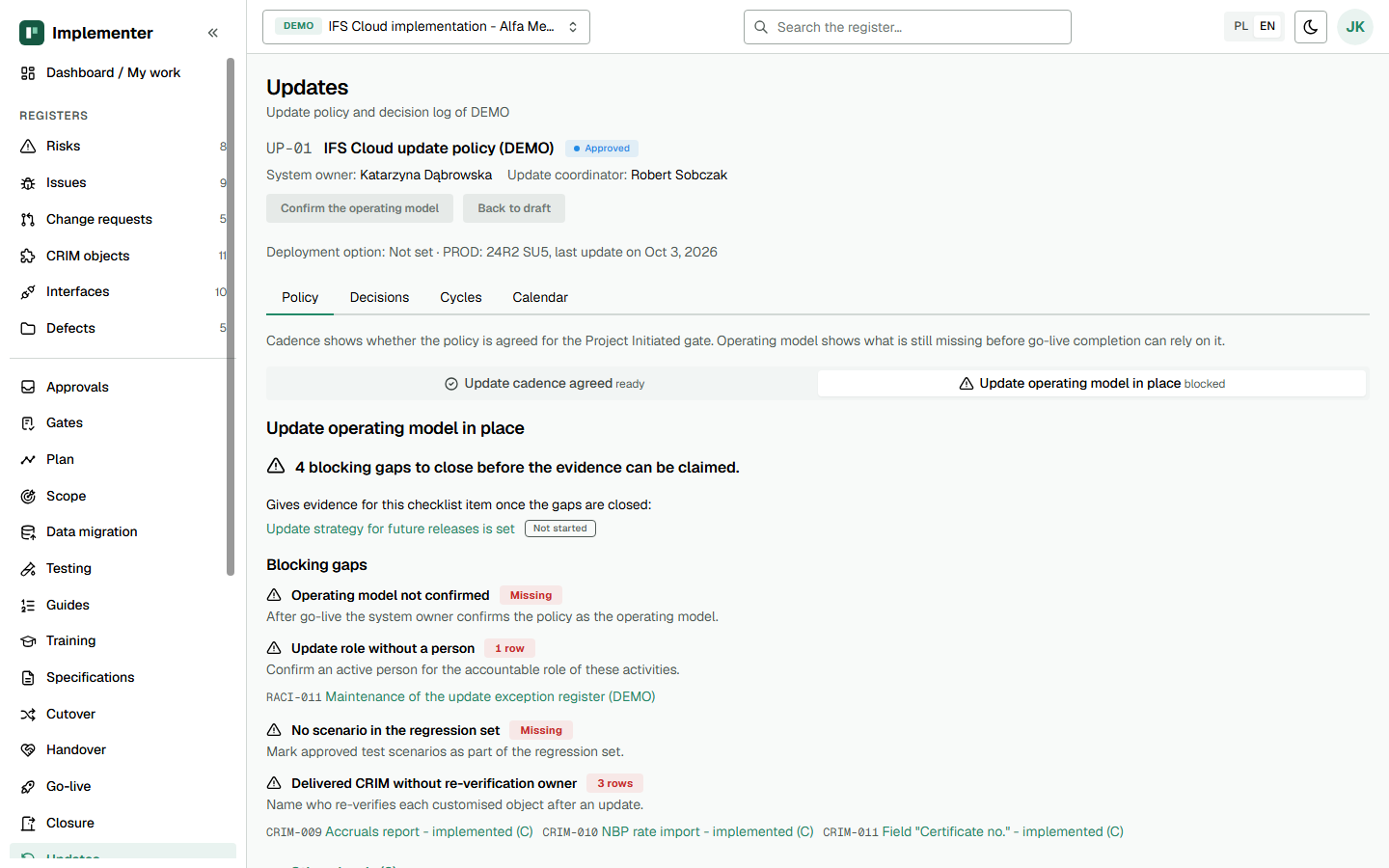
In BAU mode Implementer runs each IFS Cloud service or release update as a managed cycle with a plan, a verification stage with a regression pack and drift checks, and a recorded production decision.
How does an update cycle run?
Every service or release update is a cycle with three stages and a decision on record.
Plan
Window, scope, CRIM objects and interfaces affected, freeze periods and environment rules from the update policy.
Verify
Re-verify CRIM objects, check interfaces, run the pinned regression pack and read the drift check against IFS.
Decide
The production decision goes through approval, with the system owner, optional supplier verification and the chair of IT governance.
What is BAU and Evergreen mode?
BAU and Evergreen mode is the project mode in Implementer for the time after go-live, when IFS Cloud keeps changing through service updates and release updates. There are no implementation phases. The Go-live and Closure pages are hidden, and the Updates page opens on the cycles. The mode builds on IDK-23, the update strategy template. Compare it with new implementation and rollout.
What does the update policy hold?
The update policy is one record per project that fixes the rules before the first update arrives:
- cadence decisions and freeze periods,
- the role that may approve an exception,
- environment rules for refreshes and overwrites,
- the regression scope and the customisation policy,
- the system owner and the update coordinator.
Each later decision (cadence, exception, customisation, environment, regression) is an entry in the update decision log with a reason, a date, a decider and a review date. See the glossary for Evergreen and CRIM.
What is in an update cycle?
Each cycle has a verdict for three stages: plan, verification and decision. In verification you work through the six-step impact assessment from the template: CRIM re-verification, interface checks and regression. The regression pack of a cycle pins the scenarios worth re-running and judges them against their latest results, instead of inventing the regression for every release. A calendar shows update windows, refreshes and freeze periods.
How does the IFS check work?
Implementer reads from IFS Cloud through read-only OData, with one OAuth2 client per environment. A drift check compares the stored projection results and flags what changed. A blocking drift check and an informational stale check feed the verification stage, so the team sees a change before users report it. Implementer never writes to IFS. See security and trust.
What else belongs in BAU?
Support requests and the handover records from the implementation stay in the same project, so the knowledge does not leave with a person. AI search and chat answer from those records with citations to the source.
What does it cost?
A BAU and Evergreen licence is EUR 3,600 per project and year, up to 25 named users, net, plus VAT. See pricing, the pilot and the FAQ. You can also open the live demo or book a scoping call.
Last updated: