Product
IFS Cloud projects fail in the gaps, not in the software
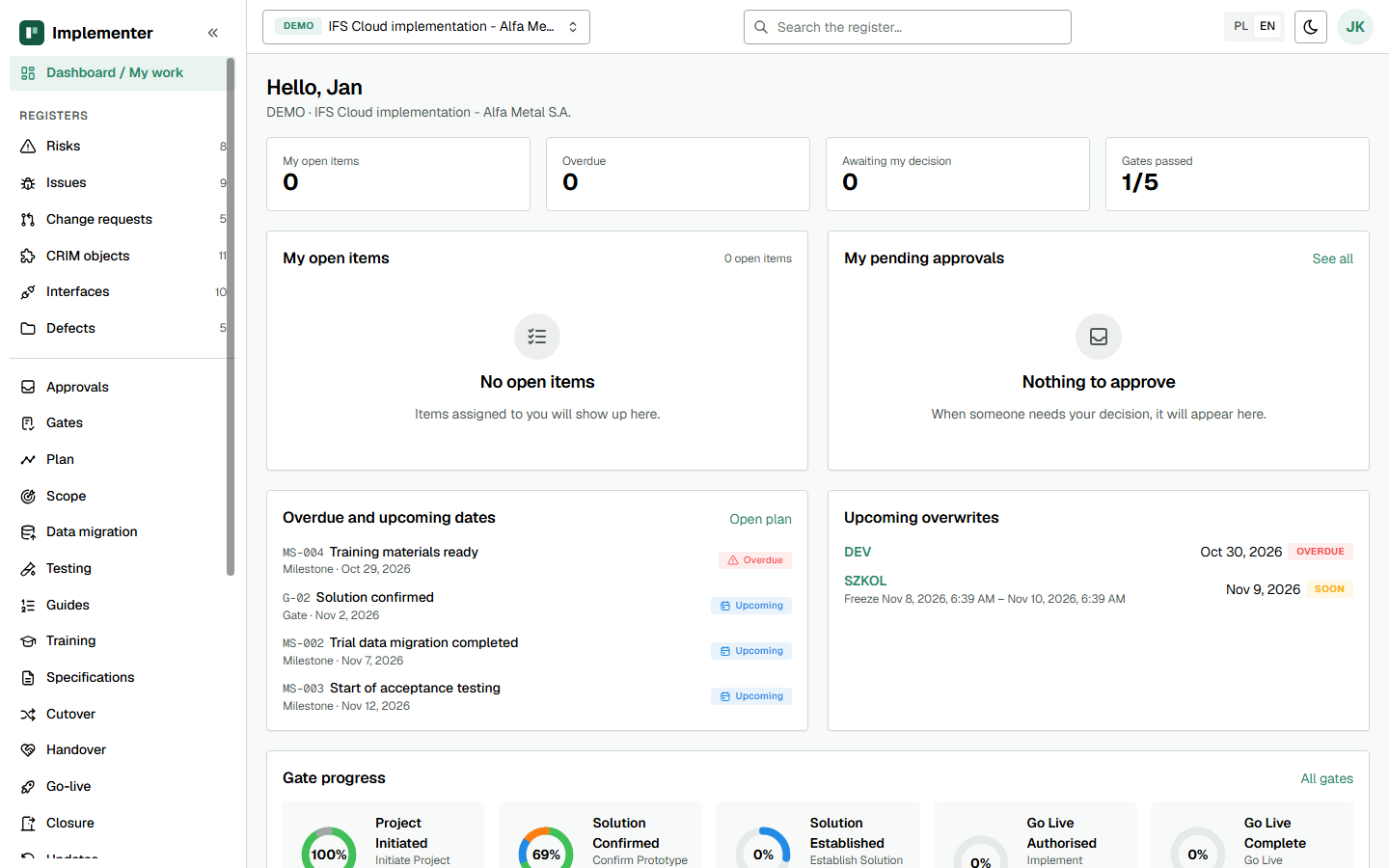
Implementer is a self-hosted application that runs an IFS Cloud implementation, rollout or BAU project from registers instead of documents, so every gate decision, approval and change has an owner, a date and a history.
Which problems does Implementer close?
Eight gaps between people, files and decisions, from the first workshop to the last update.
Readiness
A gate verdict computed from evidence, not opinions in a meeting.
Scope
One CRIM register with impact and decision history for every request.
Data migration
Reconciliation by object, tolerance per object, sign-off per data group.
Testing
A result for every test step and a cycle verdict on record.
Accountability
Approvals bound to the exact version, every change audited.
Updates
A pinned regression pack and drift checks for every IFS update cycle.
Knowledge
Search and chat over your own project records, with citations.
Reporting
Status and steering reports generated from the same registers.
Which projects is it for?
Three journeys, one way of working. The mode is set per project.
New implementation
Take a project from initiation to go-live through five gates with evidence and sign-offs.
Rollout
Reuse the approved design for the next site or country. Record what is local.
BAU and Evergreen
Run IFS updates as managed cycles with regression packs, drift checks and decisions on record.
Why can a cautious customer say yes?
Six design decisions, described in detail on the security and trust page.
AI never approves
Drafts for a human only. No status changes, no decisions.
IFS access is read-only
OData with a per-environment account. Implementer never writes to IFS.
Authorisation in three places
The API, row-level security in PostgreSQL and the AI retrieval filter.
Every change is audited
Who, when and from where, for UI, API, AI and import.
Runs in your infrastructure
Signed container images behind one reverse proxy, non-root, read-only.
Methodology is configuration
Phases, gates and approvals live in a versioned pack, not in code.
What does Implementer cost?
Start with a fixed-price pilot. The fee is credited against the first-year licence. Net prices, plus VAT.
Pilot from EUR 3,450
Mirror 3,450 (30 days), Standard 6,900 (90 days, first three 4,800), Extended 13,800.
Licence from EUR 3,600 a year
Per project, up to 25 named users: 9,600 new implementation, 6,000 rollout, 3,600 BAU.
Leaving is an export
Data stays in your database and file store. Registers are readable through the API.
How do you start?
Close one gap this quarter.
See it on your project
A scoping call and a walkthrough with your own scope and gates.
Pick the gap that hurts most
Migration, testing, updates or approvals.
Run a pilot
One project, one team, measured on its first gate.
What is Implementer?
Implementer is a self-hosted web application for IFS Cloud project managers, solution architects and customer PMOs. It runs the 24 templates of the Implementation Docs Kit (IDK) as registers. A risk, a CRIM object, a test cycle or a gate decision is a row with an owner, a state and a history, and the documents are generated views over those rows. Read more on the product page and in the glossary.
Who builds it?
Implementer is built by Dariusz Myśliwiec, an independent IFS Cloud consultant at IFS-ERP. It is an independent product and not an official IFS product.
What does it not do?
IFS integration is read-only, AI never approves anything or changes a status, and Teams and calendar integration is not yet proven on a production tenant. The full list is on the security and trust page.
Where can you try it?
The live demo runs on demo data about a fictional company, Alfa Metal S.A. See before and after for the difference in daily work, the pilot for the first step, or book a scoping call.
IFS is a registered trademark of IFS.
Last updated: